Showing posts with label information. Show all posts

Wednesday, April 21, 2010

The Secret to Weight Loss

This is a "common misconceptions" post that I've been meaning to do for a long time, and thanks to a recent article in The New York Times I finally have a good reason. More on that later.

Everybody knows weight loss is a big deal, the fact is obvious from the astounding range of products/services with weighty promises (lose 30 pounds in 30 days!!!); the advertisements assault us constantly, from every possible angle. Given that the majority of US Americans are considered overweight in a culture with highest regards only for the exact opposite build, it's really no surprise that weight loss is big business. The real surprise is just how successful such ventures are when practically all of them make explicitly outrageous claims and just as many (if not more) are wholly ineffective. The truth is that with few exceptions commercial weight loss products are simply fraudulent--they are designed to take your money, not to help you lose weight.

I know the secret to losing weight, and I'm willing to share it... for free! It is very simple, and not simple in the subtly very complicated way, just simple. Ready?

How to lose weight:  Eat less.

 It's a matter of physics. Imagine an extreme case where a person doesn't eat or drink anything; by the very laws of nature and obvious from elementary intuition, it is impossible for that person to gain weight. This would be just like setting a scale in a sealed room: it would be very silly to think that the scale might at any point suddenly measure any more weight than it has all along. Humans are magnificently, extraordinarily, incomprehensibly complex systems, but that doesn't exempt us from the laws of physics. Unless more stuff is added to a body, that body will either maintain or lose weight. In case it isn't obvious, let me remind you that abstaining from all consumption for longer than a little while is a bad idea--remember, the rule is to eat less, not to eat nothing.

Let's explore the physics in slightly more detail. The main reason we eat is to supply our body with energy; our bodies need fuel to keep the magic alive, just like a car needs gas to move. Clearly it would be a bad setup if the energy we consume couldn't be stored, like a car without a gas tank we wouldn't get very far. There are a variety of ways the human body can store energy, but the presently relevant one is best known as fat. Call me crazy, but next time you see that extra bit of flab, try being grateful--if it weren't for that "unsightly" bit of excess, a few missed meals would result in death. I don't know about you, but I'd rather have a less than optimal social image than be dead.

So fat is stored energy, but what's this energy? Is there any way to quantify it so that its consumption might be regulated? In fact, yes, there is! The energy in food is also known as Calories, which is actually a kilocalorie or 1,000 calories. A calorie is a unit of energy, just like an hour is a unit of time. If you eat 2,000 Calories in a day and only use half of them, the rest will be stored, with some portion of them being stored as fat, it's as simple as that! If you are gaining weight and it's not because you're building muscle mass, you are eating more energy than you're using. Here's the Eureka moment!

How to lose weight (revised): Eat fewer calories than you use.

But wait, what about fatty foods, exercise, and metabolism, don't these play a major role in weight loss? Lets look at each of them.

Fatty Foods
One of the strongest diet related misconceptions around is that eating foods with excess fat, saturated, unsaturated, or otherwise will lead to increased body fat. This isn't true, food fat doesn't automatically turn into body fat. Perhaps this misconception arose because lipid nutrients and adipose tissue are both known colloquially as fat, but the notion that consumed lipids will transform into adipose tissue is as silly as the notion that eating brain will make a person smarter. Anybody can eat pure fat every day and lose weight, because the amount of fat in a food doesn't matter for weight management, what matters is the amount of Calories in the food and how much food (ergo how many Calories) is consumed. It's true that fat, with 9 Calories per gram, has a higher energy density than protein and carbohydrates, which have 4 Calories per gram, but for the purposes of weight loss this is moot--all Calories in a food, regardless of the source, are accounted for by the "Calories" figure on every nutritional label. Predictably there's a fair degree of complexity in how effectively food energy is captured, but the given number of Calories represents the maximum; if you closely regulate energy intake, you will realize there are no magical foods that cause body fat. Often, however, energy intake is far from regulated, far even from monitored, and it is very easy to underestimate how many Calories are eaten in a day. One case deserves special mention: high-fructose corn syrup (HFCS), the modern sweetener du jour, has been shown in a recent Princeton study to lead to more weight gain in mice than equal amounts of cane sugar. The theory I've heard is that HFCS is far more easily digested than cane sugar, and since digestion requires energy, HFCS results in more energy than an equal amount of sugar.

Exercise
When people think weight loss, they usually think exercise. It's always a point of contention when I say it, but exercise does very little to hasten weight loss. The reason is that the body burns a lot of energy no matter what its doing; for most people exercise causes only a marginal increase in energy consumption from the already high baseline. Remember the NYTimes article I mentioned? Here's a quote from it:
“In general, exercise by itself is pretty useless for weight loss,” says Eric Ravussin, a professor at the Pennington Biomedical Research Center in Baton Rouge, La., and an expert on weight loss.
The exception here is athletes, whom require many more calories than everybody else. This is because athletes have bodies that are especially efficient in utilizing energy--in other words, they have a higher basal metabolic rate. For those of us who aren't professionally physically fit, the connection between exercise and weight loss isn't anywhere near as clear cut. For more information on this topic I recommend reading the aforementioned NYTimes article: "Weighing the Evidence on Exercise." Beyond weight loss, keep in mind that frequent aerobic exercise is universally acknowledged as a critical component in the maintenance of cardiovascular health.

Metabolism
One of my pet-peeves, if you can call it that, is when people disseminate false information. We live in an age when almost the full knowledge of Earth is accessible on demand, so the reasoning goes that it's time we stop defaulting to wild speculation and just google it. Of course I have nothing wrong with wild speculation, my displeasure arises when the speculation is presented as fact. I'm bringing this up because it's relevant to the topic at hand, metabolism. Everybody has heard the word, it's used all the time, especially in regard to weight management, but what does it mean? What is metabolism? For all the mention it gets, I'd think everyone would be familiar with what exactly was being referred to. If you visit the Wikipedia page for metabolism, you might find that the subject is rather complicated; the summary refers to cellular respiration, metabolic pathways, and the carboxylic acids that are part of the citric acid cycle. That doesn't sound like weight loss! Metabolism is something of a shotgun term that refers to the chemistry of life. The basal metabolic rate is a bit more specific, as it refers to the amount of energy an organism expends while at rest and in a post-absorptive state. Since basal metabolic rate is roughly energy expenditure, it must be able to indicate how many Calories are needed to manage weight, and indeed it does. Interestingly enough, metabolic rate is strongly correlated with lean muscle mass and the same figure has been arrived at for all people: 16 Calories per pound of lean mass per day. This means an estimate for how many Calories you need each day can be found by multiplying your lean mass by 16. This also indicates what has been shown in other studies as well: the best known way to increase the basal metabolic rate is by increasing lean muscle mass.

Just one final note: losing more than a pound or two a week is neither healthy nor permanent.

Wednesday, April 7, 2010

SparkFun SEN09423 integration issues

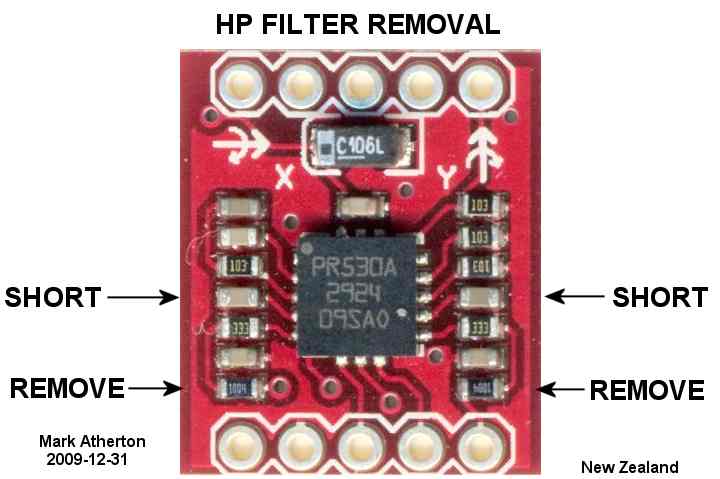
Anyone seeking to use SparkFun's SEN09423 breakout board for the LPY530AL as a position sensor should be advised that the two 4.7 µF capacitors (C1 and C2 on the schematic) used for the high pass filter need to be removed and the contacts bridged. This image shows which tiny bits are of concern, however note that it seems the resistors indicated therein do not need to be removed. This information comes thanks to a few people who know what they're doing (which excludes myself), as discussed on the SparkFun forums here and here. From what I gather this may be an issue with numerous (all?) SparkFun breakouts including ST rate gyros, the two threads alone implicate boards containing LPR530AL or LPY530AL, including the IMU 6DOF Razor. This is a particularly odd case because Inertial Measurement Units are mostly used for dead-reckoning, and the inclusion of these caps will effectively frustrate anyone with such an intent. As far as removing them, good luck! Here's my own picture of how gigantic these caps are:


I found the best luck (given a fine tip soldering iron) with adding a little solder to one side so that solder wick can get most of it. Then just heat up the other side and push gently. The first one I removed took the contact pad with it, if that happens to you you may or may not be high and dry. I managed to salvage the situation by drawing between the appropriate areas with a pencil. In case you weren't aware, graphite is conductive--clearly this is a handy bit of information on occasion.

For a slightly more general audience, here's some interesting information. The capacitors pictured are about 0.065 inches wide, or 1.66 mm; the skinny dimension of the penny pictured is about 1.52 mm. I said these capacitors are gigantic, and relatively speaking this is true! Relative to molecules, light rays, and subatomic particles sure, but also relative to the vast majority of capacitors out there. We will get to how in a minute, but first a brief overview. The electronic components most of us are used to seeing are the ones attached to those (usually) green boards also known as circuit boards, like this one:


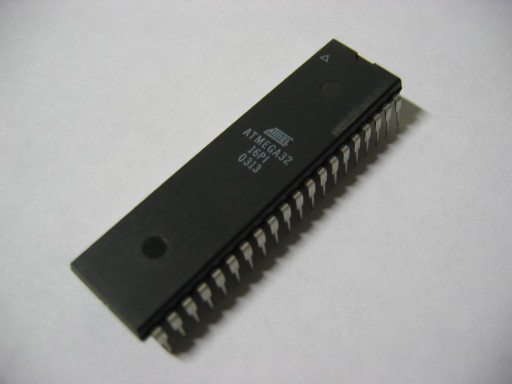
These days most circuit boards we encounter are printed circuit boards or PCBs, called such because the production process resembles printing to varying degrees. The principle elements of a PCB are, put simply, fiberglass, copper or other conductive metal, and solder mask. The fiberglass makes up the board-ness, the copper is akin to wiring for conducting electricity amongst the components, and the solder mask, the colored part, is a coating that solder doesn't stick to, in place so that connections aren't made accidentally by wandering solder. Not too long ago, I thought the PCB was made of silicon; after all, electronics are associated with silicon, and from a naive perspective the shiny green board looks like something that might be called silicon. But if that's not it, where's the silicon? In an IC of course! These days most all the action of an electronic device happens in an Integrated Circuit, which looks something like this:


Inside that chunk of plastic there's a wafer of silicon, which could contain anywhere from hundreds to Billions of electronic components. Wouldn't it be nice if there was a window that showed the silicon? Like this one?


Instead of discrete components like the capacitors I shared above, these components are formed by spraying (very precisely) successive layers of various chemicals in a process called photolithography, resulting in something like a miniature PCB. The CPU is the biggest, most complicated IC in the box that is your computer (unless you have a very fancy video card), and because of this it looks different than all the others. For one, you can't even see it, it's hidden underneath a big heatsink, which is there to help get rid of all the electricity that turns into heat in the CPU (the process is conceptually similar to heat generated from friction). CPUs generate so much heat that one would burn itself to a crisp almost instantly without a heatsink. But even if you remove the heatsink (after you've turned off the computer), modern processors have another metal plate which hides another sealed package that finally contains the silicon. Here we're finally at the land of magic: as of now, April 2010, Intel has a 32 nm manufacturing process, which means that the typical component width is less than 32 nm. This also means that the 1.66 mm wide capacitor above is about 52,000 times wider than a single component on a 2010 Intel CPU, or, relatively gigantic. Granted, most things we know are relatively gigantic compared to 32 nm, particularly since that's quite a bit smaller than the shortest wavelength of visible light--violet, at 400 nm. Reality check: we're making electrical components so small that a ray of light can't even hit them, so small that even the most powerful microscope couldn't see them, way smaller than the average bacteria. Really!? Apparently that's not enough, industry projections have us with 11 nm chips in 2022, which would make each component about the same width as 55 carbon atoms. Interestingly, the first time a single carbon atom was photographed (after a manner) was 9/2009. Of course, there are certain problems that what we know as computers, that is Turing class machines, can't solve--certain problems that could be described in a hundred or so lines of computer code that would take a computer the size of the universe longer than the universe is supposed to exist to solve. Not content to take limitations as they're handed to us, work is well under way to develop a different class of computer: the quantum computer. Quantum computers are very different in that they can take very specific problems, like the one I just mentioned, and solve them instantly. I don't know enough about quantum computation to judge if they'll ever reach the ubiquity our Turing machines have, but I can say one thing for certain: there's not much certainty in the future! Intel will probably plug ahead and reach 11 nm in 2022, but the real question is will that even be relevant? I'm willing to bet not, it almost seems like sitting in 2002 and projecting that by 2012 our CPUs will run at 11 GHz; as it turns out, GHz aren't all that important. Take a top of the line 3.8 GHz Pentium 4 from 2004 and I assure you a 1.8 GHz chip from today will outperform it. Maybe the state of the art in 2022 will be a 100 MHz chip with a million cores--only time will tell.

Saturday, February 13, 2010

Technology

I've heard that some people think technology isn't really progressing at an amazing rate. I think they're crazy. I don't think I've shared this yet, it's an example of the state of technology:


Frankly, I think we have so much technology at our fingertips that we have hardly even begun to scratch the surface of what it's capable of. On top of that, better technology is hitting the scene faster than anyone can keep up with. I certainly think that we are in a technological singularity, and that Kurzweil's condition (strong artificial intelligence) is satisfied by our own intelligence as augmented by the Internet. It's a subtle, almost secret form of artificial intelligence that, from what I gather, no one has yet realized the significance of. With the power of the Internet, a person, so willing, may learn practically anything, and at record speed--no digging through card catalogs or driving to the library necessary. Suppose you want to learn engineering but can't afford school? No problem, one of the best engineering schools in the country, MIT, has put all course materials for the first four introductory engineering courses online (lectures, notes, assignments, labs, etc) for free, available to anyone with an Internet connection. You'd probably want more than an introduction, so it's a good thing they've made freely available most of their curriculum, including that from other programs. You don't get any certificate, but does that really matter? I'm certain that a degree is worthless in lieu of an education, and that an education is no less valid if it isn't certified. This isn't a new fact, it's just easier to get an uncertified education now than it has been in the past. Take Dean Kamen, the man behind this amazing prosthetic arm and many other similarly astounding creations--he didn't earn even an undergraduate degree, though he now has around 7 honorary doctorates. The real point is that now other potential Kamens are easily able to obtain the resources necessary for their talent to reach fruition. An important addition is that I think most people have more potential than is generally realized; if this is true, than we should expect a significant increase in technological progression. The question I'll leave for you to answer then is this: have we seen a significant increase in technological progression since the Internet became widely available?

Saturday, September 19, 2009

Information, a perspective

Fair warning: I'm about to talk about math. However, I don't think you need to know or even like math to enjoy this. Suppose I were to tell you that the following images were both of the same thing. Would you believe me?


Unless you know multivariable functions or are pretty slick, you probably think I'm crazy. However, I can assure you that these are simply two different perspectives of the exact same shape; the only thing that has changed from one to the next is the place from which you are looking at it. If you're a skeptic (and I hope you are), you still don't believe me. Fair enough, but look at the animation after the jump and you don't have to believe me--you will see it with your own eyes.