Showing posts with label technology. Show all posts
Showing posts with label technology. Show all posts
Friday, March 4, 2011
While Life Proceeds Obliviously Below
Google has a tendency to do what they say they might, and thus it was with a mixture of surprise and expectation that I noticed the Google Maps aerial view of Salt Lake have been updated to include UAV footage, clearly higher resolution as individual people can be discerned. The colors are also much better. Zoom all the way in on this map to see for yourself.


Monday, November 15, 2010
Reality made Virtual
In case you hadn't heard, Microsoft recently released a new accessory for their game console called the Kinect. Without going into much detail, the Kinect is packed with some advanced electronic sensors. Some people are unwilling simply to take what has been offered them as it is--these are true, free individuals, actively exercising volition; call them hackers. Within days of being released, the Kinect was unleashed, hacked to fill a bounty. Here we are, 11 days later, and one hacker has built on top of the work of other similarly intrepid minds something profound; as seen on hackaday, it is reality made virtual:
Sunday, April 18, 2010
Nexus One, an Android
I've had an iPhone since shortly after they were first released, nearly three years now. For the most part, I've enjoyed it. These days, particularly when it comes to electronic devices, three years is a really long time; as such, it's almost difficult to recall why the iPhone had the hype it had. One thing to recall is that the app store, which is now probably the most attractive and well known feature of the phone, didn't exist when the phone first came out. The reason the iPhone was viewed as revolutionary (and that it was) was because it was the first cell phone to give what could be called functional access to the Internet, where most all websites were available to a mobile phone without any modifications. Clearly the Internet has revolutionized society; the movement from being available only on home computers to being available almost anywhere with cell reception is undoubtedly a movement that has been similarly transformative.
The availability of the whole content of the Internet, many Terabytes of information, on a diminutive device feeling like a polished stone, is practically inconceivable to me. But the notion is one conceived many times over in the science fiction canon. The most obvious example I know of is the device which shares the name of the book in which it resides: The Hitchhiker's Guide to the Galaxy. In his remarkable series Cosmos, Carl Sagan repeatedly fantasizes about perusing the fundamentally similar, fictional Encyclopaedia Galactica, a compendium of all the knowledge gathered throughout the existence of an intergalactic species. Both of these bits of media originate around 1978, a time in which something like the iPhone and the Internet must have been considered far out by any reasoning; it is apparent that at least two foraward thinking people saw such a device as a product of civilizations living on a galactic scale.
From 1978 the iPhone must have been a long way away, considering the primitive original Apple Macintosh didn't even hit the market until January of 1984, though development started in 1979. The Macintosh had an 8 MHz processor, 128 KB of RAM, and a 9" 512x342 monochrome display. Fast forward 23.5 years, and though our progress in intergalactic exploration hadn't much changed from naught, our computers had made unexpected advances! The original iPhone runs at 412 MHz, 128 MB of RAM, and a 3.5" 320x480 18-bit color display--it's roughly 52 times faster, has 1,000 times more memory, and a far superior display. It fits in a pocket and can run all day without needing a charge, it can replace books, newspapers, televisions, and the list goes on beyond any reasonable expectations.
Three years later, the revolution of Internet on a phone has taken place, and giant leap taken all that remains is incremental improvements: the Nexus One. This past December there was a buzz about the web as rumors of a Google phone spread. The buzz persisted for a little while and then mysteriously subsisted. The Google phone arrived almost as if it were secret all along, almost as if it remained a secret--from what I've read, the sales of the device aren't remotely as impressive as those for the iPhone. But for what it lacks in popular perception, it makes up for in spec: 1 GHz processor, 512 MB RAM, 3.7" 800x480 display, or about twice an iPhone. Having just recently mentioned that GHz isn't a very important measure, I'd be foolish to regard that as a concrete measure of performance; it isn't, but the Nexus One noticeably outperforms the iPhone in every respect. Interestingly enough, the Nexus One matches or exceeds the recently released iPad in almost every spec except for screen resolution--it's truly a remarkable device.
One of the things about today's cell phones, also called smart phones or super phones, is that they're actually powerful little computers masquerading as phones. The iPhone does a very good job at hiding the power under it's hood, and this is very much one of the reasons I chose to go with a Nexus One over another iPhone; the Nexus One has only a thin veil to hide the fact that it's a computer running a version of Linux. In order to write an application for the iPhone, one needs to pay Apple about $100 to apply for the opportunity. If they choose to accept you, there are a number of steps to follow, including authorizing a particular device, associating it with a particular machine, writing particular code, and accepting a very hefty agreement which includes conditions such as not displaying your device in public and the right of Apple to take ownership of your code without notification or recompense. The $100 only covers one year--every year requires another $100 to continue participation. I did go through this process at some point, but I didn't get as far as getting code onto a device before my membership expired; after that, I gave up. The Nexus One is a different story: anyone can write anything and put it on their phone at any time, for free. The first day I had my new phone I had a custom application uploaded to it. The second day I gained root access, installed a custom bootloader and a modified version of the Android operating system known as CyanogenMod; in other words, I now own my phone.
The subject of science fiction is relevant for one last note: the name Nexus One comes from the most advanced android in a story called "Do Androids Dream of Electric Sheep?" better known as "Blade Runner," by Philip K. Dick.
Nothing says "I'm a geek and I know what I'm doing" like a command line:

One thing that really stands out about the Nexus One versus the iPhone is the much higher resolution display (click to see a version large enough to tell the difference, also note that some aliasing in the form of red, blue, and green banding may appear depending on your monitor):

Here's a side by side comparison:

There are still a few things I like about one more than the other, but the power of the Nexus One is that I can change nearly everything as I see fit--the same most certainly cannot be said for the iPhone.
The availability of the whole content of the Internet, many Terabytes of information, on a diminutive device feeling like a polished stone, is practically inconceivable to me. But the notion is one conceived many times over in the science fiction canon. The most obvious example I know of is the device which shares the name of the book in which it resides: The Hitchhiker's Guide to the Galaxy. In his remarkable series Cosmos, Carl Sagan repeatedly fantasizes about perusing the fundamentally similar, fictional Encyclopaedia Galactica, a compendium of all the knowledge gathered throughout the existence of an intergalactic species. Both of these bits of media originate around 1978, a time in which something like the iPhone and the Internet must have been considered far out by any reasoning; it is apparent that at least two foraward thinking people saw such a device as a product of civilizations living on a galactic scale.
From 1978 the iPhone must have been a long way away, considering the primitive original Apple Macintosh didn't even hit the market until January of 1984, though development started in 1979. The Macintosh had an 8 MHz processor, 128 KB of RAM, and a 9" 512x342 monochrome display. Fast forward 23.5 years, and though our progress in intergalactic exploration hadn't much changed from naught, our computers had made unexpected advances! The original iPhone runs at 412 MHz, 128 MB of RAM, and a 3.5" 320x480 18-bit color display--it's roughly 52 times faster, has 1,000 times more memory, and a far superior display. It fits in a pocket and can run all day without needing a charge, it can replace books, newspapers, televisions, and the list goes on beyond any reasonable expectations.
Three years later, the revolution of Internet on a phone has taken place, and giant leap taken all that remains is incremental improvements: the Nexus One. This past December there was a buzz about the web as rumors of a Google phone spread. The buzz persisted for a little while and then mysteriously subsisted. The Google phone arrived almost as if it were secret all along, almost as if it remained a secret--from what I've read, the sales of the device aren't remotely as impressive as those for the iPhone. But for what it lacks in popular perception, it makes up for in spec: 1 GHz processor, 512 MB RAM, 3.7" 800x480 display, or about twice an iPhone. Having just recently mentioned that GHz isn't a very important measure, I'd be foolish to regard that as a concrete measure of performance; it isn't, but the Nexus One noticeably outperforms the iPhone in every respect. Interestingly enough, the Nexus One matches or exceeds the recently released iPad in almost every spec except for screen resolution--it's truly a remarkable device.
One of the things about today's cell phones, also called smart phones or super phones, is that they're actually powerful little computers masquerading as phones. The iPhone does a very good job at hiding the power under it's hood, and this is very much one of the reasons I chose to go with a Nexus One over another iPhone; the Nexus One has only a thin veil to hide the fact that it's a computer running a version of Linux. In order to write an application for the iPhone, one needs to pay Apple about $100 to apply for the opportunity. If they choose to accept you, there are a number of steps to follow, including authorizing a particular device, associating it with a particular machine, writing particular code, and accepting a very hefty agreement which includes conditions such as not displaying your device in public and the right of Apple to take ownership of your code without notification or recompense. The $100 only covers one year--every year requires another $100 to continue participation. I did go through this process at some point, but I didn't get as far as getting code onto a device before my membership expired; after that, I gave up. The Nexus One is a different story: anyone can write anything and put it on their phone at any time, for free. The first day I had my new phone I had a custom application uploaded to it. The second day I gained root access, installed a custom bootloader and a modified version of the Android operating system known as CyanogenMod; in other words, I now own my phone.
The subject of science fiction is relevant for one last note: the name Nexus One comes from the most advanced android in a story called "Do Androids Dream of Electric Sheep?" better known as "Blade Runner," by Philip K. Dick.
Nothing says "I'm a geek and I know what I'm doing" like a command line:

One thing that really stands out about the Nexus One versus the iPhone is the much higher resolution display (click to see a version large enough to tell the difference, also note that some aliasing in the form of red, blue, and green banding may appear depending on your monitor):

Here's a side by side comparison:

There are still a few things I like about one more than the other, but the power of the Nexus One is that I can change nearly everything as I see fit--the same most certainly cannot be said for the iPhone.
Wednesday, April 7, 2010
SparkFun SEN09423 integration issues
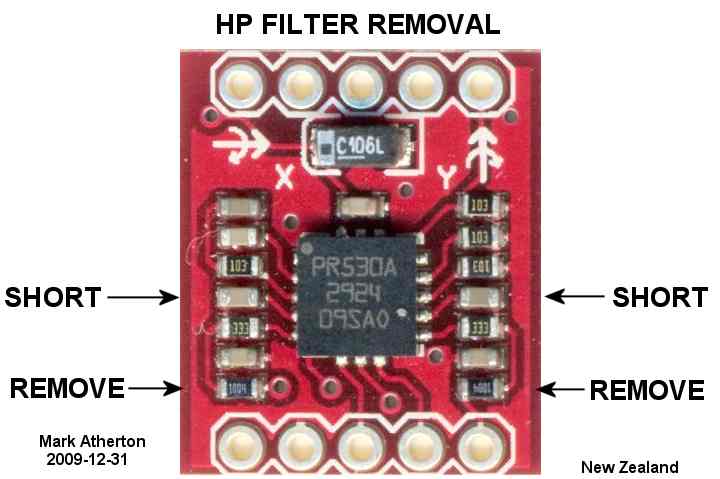
Anyone seeking to use SparkFun's SEN09423 breakout board for the LPY530AL as a position sensor should be advised that the two 4.7 µF capacitors (C1 and C2 on the schematic) used for the high pass filter need to be removed and the contacts bridged. This image shows which tiny bits are of concern, however note that it seems the resistors indicated therein do not need to be removed. This information comes thanks to a few people who know what they're doing (which excludes myself), as discussed on the SparkFun forums here and here. From what I gather this may be an issue with numerous (all?) SparkFun breakouts including ST rate gyros, the two threads alone implicate boards containing LPR530AL or LPY530AL, including the IMU 6DOF Razor. This is a particularly odd case because Inertial Measurement Units are mostly used for dead-reckoning, and the inclusion of these caps will effectively frustrate anyone with such an intent. As far as removing them, good luck! Here's my own picture of how gigantic these caps are:

I found the best luck (given a fine tip soldering iron) with adding a little solder to one side so that solder wick can get most of it. Then just heat up the other side and push gently. The first one I removed took the contact pad with it, if that happens to you you may or may not be high and dry. I managed to salvage the situation by drawing between the appropriate areas with a pencil. In case you weren't aware, graphite is conductive--clearly this is a handy bit of information on occasion.
For a slightly more general audience, here's some interesting information. The capacitors pictured are about 0.065 inches wide, or 1.66 mm; the skinny dimension of the penny pictured is about 1.52 mm. I said these capacitors are gigantic, and relatively speaking this is true! Relative to molecules, light rays, and subatomic particles sure, but also relative to the vast majority of capacitors out there. We will get to how in a minute, but first a brief overview. The electronic components most of us are used to seeing are the ones attached to those (usually) green boards also known as circuit boards, like this one:

These days most circuit boards we encounter are printed circuit boards or PCBs, called such because the production process resembles printing to varying degrees. The principle elements of a PCB are, put simply, fiberglass, copper or other conductive metal, and solder mask. The fiberglass makes up the board-ness, the copper is akin to wiring for conducting electricity amongst the components, and the solder mask, the colored part, is a coating that solder doesn't stick to, in place so that connections aren't made accidentally by wandering solder. Not too long ago, I thought the PCB was made of silicon; after all, electronics are associated with silicon, and from a naive perspective the shiny green board looks like something that might be called silicon. But if that's not it, where's the silicon? In an IC of course! These days most all the action of an electronic device happens in an Integrated Circuit, which looks something like this:

Inside that chunk of plastic there's a wafer of silicon, which could contain anywhere from hundreds to Billions of electronic components. Wouldn't it be nice if there was a window that showed the silicon? Like this one?

Instead of discrete components like the capacitors I shared above, these components are formed by spraying (very precisely) successive layers of various chemicals in a process called photolithography, resulting in something like a miniature PCB. The CPU is the biggest, most complicated IC in the box that is your computer (unless you have a very fancy video card), and because of this it looks different than all the others. For one, you can't even see it, it's hidden underneath a big heatsink, which is there to help get rid of all the electricity that turns into heat in the CPU (the process is conceptually similar to heat generated from friction). CPUs generate so much heat that one would burn itself to a crisp almost instantly without a heatsink. But even if you remove the heatsink (after you've turned off the computer), modern processors have another metal plate which hides another sealed package that finally contains the silicon. Here we're finally at the land of magic: as of now, April 2010, Intel has a 32 nm manufacturing process, which means that the typical component width is less than 32 nm. This also means that the 1.66 mm wide capacitor above is about 52,000 times wider than a single component on a 2010 Intel CPU, or, relatively gigantic. Granted, most things we know are relatively gigantic compared to 32 nm, particularly since that's quite a bit smaller than the shortest wavelength of visible light--violet, at 400 nm. Reality check: we're making electrical components so small that a ray of light can't even hit them, so small that even the most powerful microscope couldn't see them, way smaller than the average bacteria. Really!? Apparently that's not enough, industry projections have us with 11 nm chips in 2022, which would make each component about the same width as 55 carbon atoms. Interestingly, the first time a single carbon atom was photographed (after a manner) was 9/2009. Of course, there are certain problems that what we know as computers, that is Turing class machines, can't solve--certain problems that could be described in a hundred or so lines of computer code that would take a computer the size of the universe longer than the universe is supposed to exist to solve. Not content to take limitations as they're handed to us, work is well under way to develop a different class of computer: the quantum computer. Quantum computers are very different in that they can take very specific problems, like the one I just mentioned, and solve them instantly. I don't know enough about quantum computation to judge if they'll ever reach the ubiquity our Turing machines have, but I can say one thing for certain: there's not much certainty in the future! Intel will probably plug ahead and reach 11 nm in 2022, but the real question is will that even be relevant? I'm willing to bet not, it almost seems like sitting in 2002 and projecting that by 2012 our CPUs will run at 11 GHz; as it turns out, GHz aren't all that important. Take a top of the line 3.8 GHz Pentium 4 from 2004 and I assure you a 1.8 GHz chip from today will outperform it. Maybe the state of the art in 2022 will be a 100 MHz chip with a million cores--only time will tell.

I found the best luck (given a fine tip soldering iron) with adding a little solder to one side so that solder wick can get most of it. Then just heat up the other side and push gently. The first one I removed took the contact pad with it, if that happens to you you may or may not be high and dry. I managed to salvage the situation by drawing between the appropriate areas with a pencil. In case you weren't aware, graphite is conductive--clearly this is a handy bit of information on occasion.
For a slightly more general audience, here's some interesting information. The capacitors pictured are about 0.065 inches wide, or 1.66 mm; the skinny dimension of the penny pictured is about 1.52 mm. I said these capacitors are gigantic, and relatively speaking this is true! Relative to molecules, light rays, and subatomic particles sure, but also relative to the vast majority of capacitors out there. We will get to how in a minute, but first a brief overview. The electronic components most of us are used to seeing are the ones attached to those (usually) green boards also known as circuit boards, like this one:

These days most circuit boards we encounter are printed circuit boards or PCBs, called such because the production process resembles printing to varying degrees. The principle elements of a PCB are, put simply, fiberglass, copper or other conductive metal, and solder mask. The fiberglass makes up the board-ness, the copper is akin to wiring for conducting electricity amongst the components, and the solder mask, the colored part, is a coating that solder doesn't stick to, in place so that connections aren't made accidentally by wandering solder. Not too long ago, I thought the PCB was made of silicon; after all, electronics are associated with silicon, and from a naive perspective the shiny green board looks like something that might be called silicon. But if that's not it, where's the silicon? In an IC of course! These days most all the action of an electronic device happens in an Integrated Circuit, which looks something like this:
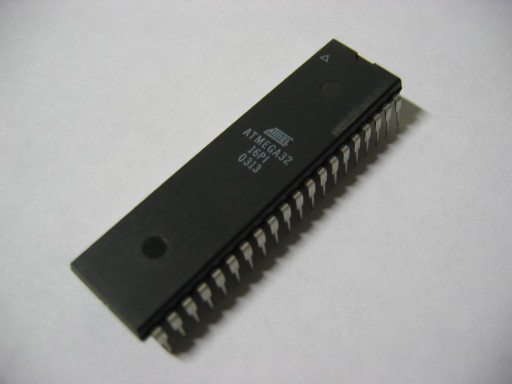
Inside that chunk of plastic there's a wafer of silicon, which could contain anywhere from hundreds to Billions of electronic components. Wouldn't it be nice if there was a window that showed the silicon? Like this one?

Instead of discrete components like the capacitors I shared above, these components are formed by spraying (very precisely) successive layers of various chemicals in a process called photolithography, resulting in something like a miniature PCB. The CPU is the biggest, most complicated IC in the box that is your computer (unless you have a very fancy video card), and because of this it looks different than all the others. For one, you can't even see it, it's hidden underneath a big heatsink, which is there to help get rid of all the electricity that turns into heat in the CPU (the process is conceptually similar to heat generated from friction). CPUs generate so much heat that one would burn itself to a crisp almost instantly without a heatsink. But even if you remove the heatsink (after you've turned off the computer), modern processors have another metal plate which hides another sealed package that finally contains the silicon. Here we're finally at the land of magic: as of now, April 2010, Intel has a 32 nm manufacturing process, which means that the typical component width is less than 32 nm. This also means that the 1.66 mm wide capacitor above is about 52,000 times wider than a single component on a 2010 Intel CPU, or, relatively gigantic. Granted, most things we know are relatively gigantic compared to 32 nm, particularly since that's quite a bit smaller than the shortest wavelength of visible light--violet, at 400 nm. Reality check: we're making electrical components so small that a ray of light can't even hit them, so small that even the most powerful microscope couldn't see them, way smaller than the average bacteria. Really!? Apparently that's not enough, industry projections have us with 11 nm chips in 2022, which would make each component about the same width as 55 carbon atoms. Interestingly, the first time a single carbon atom was photographed (after a manner) was 9/2009. Of course, there are certain problems that what we know as computers, that is Turing class machines, can't solve--certain problems that could be described in a hundred or so lines of computer code that would take a computer the size of the universe longer than the universe is supposed to exist to solve. Not content to take limitations as they're handed to us, work is well under way to develop a different class of computer: the quantum computer. Quantum computers are very different in that they can take very specific problems, like the one I just mentioned, and solve them instantly. I don't know enough about quantum computation to judge if they'll ever reach the ubiquity our Turing machines have, but I can say one thing for certain: there's not much certainty in the future! Intel will probably plug ahead and reach 11 nm in 2022, but the real question is will that even be relevant? I'm willing to bet not, it almost seems like sitting in 2002 and projecting that by 2012 our CPUs will run at 11 GHz; as it turns out, GHz aren't all that important. Take a top of the line 3.8 GHz Pentium 4 from 2004 and I assure you a 1.8 GHz chip from today will outperform it. Maybe the state of the art in 2022 will be a 100 MHz chip with a million cores--only time will tell.
Friday, March 19, 2010
Technology II: State of an Art
For today's exercise, please read the following passage and give the question at the end a sincere and thoughtful rumination. Once you feel you've thoughtfully ruminated enough, watch the video.
Imagine a modern machine, one that could be called a robot, that consists of a three fingered hand mounted at the end of an arm with a range of motion similar to our own and a single camera. Given the present state of technology, which any sensible person would describe as "quite advanced," what might this arm to be capable of?
It is astounding, yes, no less should have been expected, but there is something a bit backwards about it. Traditionally machines are constructed and used because they can do some certain task vastly better than we are able to. Naturally the machine's form and means of manipulation don't resemble ours in the slightest, otherwise we'd probably not have needed it in the first place. A good number of years ago, enchanted by the ideas of Isaac Asimov, I had a strong interest in androids--humanoid robots. But even before I knew the beginning of the true technical challenges behind building an android I realized something: a person desiring to make a passable humanoid machine would save themselves a lot of effort and greatly increase their probability of success by doing so the old fashioned way, that is by seeking a viable mating partner and letting nature run its course. At the time the thought was conceived mostly as a joke, and though it's still humorous, it's also quite sensible--practically speaking I think we have more than enough roughly human shaped objects with adequately human like capabilities. Nonetheless it is almost certain that many will continue attempts to build an android, and it's far from difficult to imagine that one day a result could be described as nothing other than successful. However one thing will remain true even then, even when androids exceed our capabilities: the human form can't do everything. No matter how dexterous or sophisticated, our fat fingered mechanical offspring won't be able to manipulate the atoms of a molecule unaided; even less technical, these two handed automatons will have just as much trouble as we doing the work of three hands. This will be a small victory for three handed people as they will get to remain not yet obsolete longer than the rest of us, at least for the few moments it takes to add one more hand to the robot. All silliness aside (well ok just most of it), there's clearly a huge number of tasks which won't benefit from the superhuman but still human capacity of these imaginary androids unaugmented. This represents a significant relief since we aren't stuck waiting for these super androids to come along (which nonetheless probably isn't too far off, though given the rate of technological progress, relatively probably quite a ways off). In summary, I've basically stated in a very roundabout way that we are free to continue to augment our own similarly limited mechanics the same as we have since the invention of the first tool; we can use our already inconceivably sophisticated body of technology to extend and enhance our capabilities. Case and point, the da Vinci surgical robot. Surgeons are essentially required to have superior motor control as even the slightest irregular movement could result in a fatality. However, no matter how talented the person holding the knife with intent to open you up, there is a fundamental biological limitation to the amount of accuracy they are capable of. Rather than just hoping their home life isn't distracting them and that their cup of coffee wasn't abnormally strong that morning, the da Vinci confers peace of mind with a laundry list of features specifically designed to maximize precision by counteracting the inherent imprecision of human hands. There are over 700 worldwide, and though it is only approved for a limited number of procedures, the number is expected to continue increasing as rapidly as it has been. While it's already on it's second version, I think it's a safe bet that further enhancements will be rapidly forthcoming. Of course, the proof is in the numbers, and the numbers are unambiguous--given the choice between traditional and robot assisted surgery, choose the latter! Here's a video of it peeling a grape on live television:
In conclusion, I'm compelled to once again say the same thing I've said previously: over the past few decades in particular we've been developing foundational technologies. Because each of these have such vast potential for application, the first and most obvious few applications took hold and found success. Being as we are focused on a multitude of things wholly different from the vastness of yet unrealized and incredible possibilities that these technologies enable, it is natural to unconsciously assume that what we see is more or less the extent of what technology can offer, but this tacit assumption is, in my opinion, absolute rubbish. In particular the most overlooked and underutilized technology is cheap and powerful microprocessors; everyone knows that desktop processors keep getting more powerful without getting more expensive, but the bit of interest is that the processors of yesteryear continue to get smaller and cheaper. This fact in itself isn't unacknowledged, actually there's a well known meme that suggests a common calculator found in a high school today has more processing power than the space shuttle that delivered the Apollo astronauts to the moon and back. The overlooked bit is that that little processor can do an awful lot more than help with algebra homework. Like what? Well, I have a video demonstration of one such device, but before you watch it consider that the processor in the device shown is essentially as powerful as a 1986 state of the art desktop that cost $6500 (the Compaq Deskpro 386), can be had for around $3, and is smaller than a dime. The whole device could probably be made wholesale for under $10.
Imagine a modern machine, one that could be called a robot, that consists of a three fingered hand mounted at the end of an arm with a range of motion similar to our own and a single camera. Given the present state of technology, which any sensible person would describe as "quite advanced," what might this arm to be capable of?
It is astounding, yes, no less should have been expected, but there is something a bit backwards about it. Traditionally machines are constructed and used because they can do some certain task vastly better than we are able to. Naturally the machine's form and means of manipulation don't resemble ours in the slightest, otherwise we'd probably not have needed it in the first place. A good number of years ago, enchanted by the ideas of Isaac Asimov, I had a strong interest in androids--humanoid robots. But even before I knew the beginning of the true technical challenges behind building an android I realized something: a person desiring to make a passable humanoid machine would save themselves a lot of effort and greatly increase their probability of success by doing so the old fashioned way, that is by seeking a viable mating partner and letting nature run its course. At the time the thought was conceived mostly as a joke, and though it's still humorous, it's also quite sensible--practically speaking I think we have more than enough roughly human shaped objects with adequately human like capabilities. Nonetheless it is almost certain that many will continue attempts to build an android, and it's far from difficult to imagine that one day a result could be described as nothing other than successful. However one thing will remain true even then, even when androids exceed our capabilities: the human form can't do everything. No matter how dexterous or sophisticated, our fat fingered mechanical offspring won't be able to manipulate the atoms of a molecule unaided; even less technical, these two handed automatons will have just as much trouble as we doing the work of three hands. This will be a small victory for three handed people as they will get to remain not yet obsolete longer than the rest of us, at least for the few moments it takes to add one more hand to the robot. All silliness aside (well ok just most of it), there's clearly a huge number of tasks which won't benefit from the superhuman but still human capacity of these imaginary androids unaugmented. This represents a significant relief since we aren't stuck waiting for these super androids to come along (which nonetheless probably isn't too far off, though given the rate of technological progress, relatively probably quite a ways off). In summary, I've basically stated in a very roundabout way that we are free to continue to augment our own similarly limited mechanics the same as we have since the invention of the first tool; we can use our already inconceivably sophisticated body of technology to extend and enhance our capabilities. Case and point, the da Vinci surgical robot. Surgeons are essentially required to have superior motor control as even the slightest irregular movement could result in a fatality. However, no matter how talented the person holding the knife with intent to open you up, there is a fundamental biological limitation to the amount of accuracy they are capable of. Rather than just hoping their home life isn't distracting them and that their cup of coffee wasn't abnormally strong that morning, the da Vinci confers peace of mind with a laundry list of features specifically designed to maximize precision by counteracting the inherent imprecision of human hands. There are over 700 worldwide, and though it is only approved for a limited number of procedures, the number is expected to continue increasing as rapidly as it has been. While it's already on it's second version, I think it's a safe bet that further enhancements will be rapidly forthcoming. Of course, the proof is in the numbers, and the numbers are unambiguous--given the choice between traditional and robot assisted surgery, choose the latter! Here's a video of it peeling a grape on live television:
In conclusion, I'm compelled to once again say the same thing I've said previously: over the past few decades in particular we've been developing foundational technologies. Because each of these have such vast potential for application, the first and most obvious few applications took hold and found success. Being as we are focused on a multitude of things wholly different from the vastness of yet unrealized and incredible possibilities that these technologies enable, it is natural to unconsciously assume that what we see is more or less the extent of what technology can offer, but this tacit assumption is, in my opinion, absolute rubbish. In particular the most overlooked and underutilized technology is cheap and powerful microprocessors; everyone knows that desktop processors keep getting more powerful without getting more expensive, but the bit of interest is that the processors of yesteryear continue to get smaller and cheaper. This fact in itself isn't unacknowledged, actually there's a well known meme that suggests a common calculator found in a high school today has more processing power than the space shuttle that delivered the Apollo astronauts to the moon and back. The overlooked bit is that that little processor can do an awful lot more than help with algebra homework. Like what? Well, I have a video demonstration of one such device, but before you watch it consider that the processor in the device shown is essentially as powerful as a 1986 state of the art desktop that cost $6500 (the Compaq Deskpro 386), can be had for around $3, and is smaller than a dime. The whole device could probably be made wholesale for under $10.
Saturday, February 13, 2010
Technology
I've heard that some people think technology isn't really progressing at an amazing rate. I think they're crazy. I don't think I've shared this yet, it's an example of the state of technology:
Frankly, I think we have so much technology at our fingertips that we have hardly even begun to scratch the surface of what it's capable of. On top of that, better technology is hitting the scene faster than anyone can keep up with. I certainly think that we are in a technological singularity, and that Kurzweil's condition (strong artificial intelligence) is satisfied by our own intelligence as augmented by the Internet. It's a subtle, almost secret form of artificial intelligence that, from what I gather, no one has yet realized the significance of. With the power of the Internet, a person, so willing, may learn practically anything, and at record speed--no digging through card catalogs or driving to the library necessary. Suppose you want to learn engineering but can't afford school? No problem, one of the best engineering schools in the country, MIT, has put all course materials for the first four introductory engineering courses online (lectures, notes, assignments, labs, etc) for free, available to anyone with an Internet connection. You'd probably want more than an introduction, so it's a good thing they've made freely available most of their curriculum, including that from other programs. You don't get any certificate, but does that really matter? I'm certain that a degree is worthless in lieu of an education, and that an education is no less valid if it isn't certified. This isn't a new fact, it's just easier to get an uncertified education now than it has been in the past. Take Dean Kamen, the man behind this amazing prosthetic arm and many other similarly astounding creations--he didn't earn even an undergraduate degree, though he now has around 7 honorary doctorates. The real point is that now other potential Kamens are easily able to obtain the resources necessary for their talent to reach fruition. An important addition is that I think most people have more potential than is generally realized; if this is true, than we should expect a significant increase in technological progression. The question I'll leave for you to answer then is this: have we seen a significant increase in technological progression since the Internet became widely available?
Frankly, I think we have so much technology at our fingertips that we have hardly even begun to scratch the surface of what it's capable of. On top of that, better technology is hitting the scene faster than anyone can keep up with. I certainly think that we are in a technological singularity, and that Kurzweil's condition (strong artificial intelligence) is satisfied by our own intelligence as augmented by the Internet. It's a subtle, almost secret form of artificial intelligence that, from what I gather, no one has yet realized the significance of. With the power of the Internet, a person, so willing, may learn practically anything, and at record speed--no digging through card catalogs or driving to the library necessary. Suppose you want to learn engineering but can't afford school? No problem, one of the best engineering schools in the country, MIT, has put all course materials for the first four introductory engineering courses online (lectures, notes, assignments, labs, etc) for free, available to anyone with an Internet connection. You'd probably want more than an introduction, so it's a good thing they've made freely available most of their curriculum, including that from other programs. You don't get any certificate, but does that really matter? I'm certain that a degree is worthless in lieu of an education, and that an education is no less valid if it isn't certified. This isn't a new fact, it's just easier to get an uncertified education now than it has been in the past. Take Dean Kamen, the man behind this amazing prosthetic arm and many other similarly astounding creations--he didn't earn even an undergraduate degree, though he now has around 7 honorary doctorates. The real point is that now other potential Kamens are easily able to obtain the resources necessary for their talent to reach fruition. An important addition is that I think most people have more potential than is generally realized; if this is true, than we should expect a significant increase in technological progression. The question I'll leave for you to answer then is this: have we seen a significant increase in technological progression since the Internet became widely available?
Saturday, February 6, 2010
Demonstration of feasibility
I'm a bit too busy to give the normal glyphic flood, but as proof following my plea for autonomous vehicles this demanded mention. The Center for Automotive Research at Stanford (CARS) is planning to send an autonomous Audi up Pikes Peak at race speeds. Pikes Peak is a mountain road used as a rally stage, with surfaces varying from packed dirt to loose gravel. Actually an autonomous car has finished the course previously, but "only" at an average 25 mph. There is some reason to suspect the Stanford team will succeed in their intent, as they won DARPAs Grand Challenge and took 2nd place in their Urban Challenge; the car can at least drive 120 mph across the salt flats. I cannot wait to hear the results!
Thursday, October 8, 2009
Telescopes in Space
At first the idea of a telescope floating around in space is absurd, but any marginally knowledgeable astronomer can profess that it's a fantastic idea. Astronomy at the most fundamental level is the study of space, everything and anything that's not Earth, and it's one of the oldest realms of intrigue known to humankind; it was popular long before the scientific method wandered onto the scene, despite being very much a scientific pursuit. On one hand, that space is an old interest isn't surprising--anyone that has turned their sight to the sky on a clear, dark night knows exactly why. A gaze into what might as well be the infinite unknown, the act itself as simple as a glance at our own hands, has a way of inspiring speechless profundity in even the most uninterested amongst us. On the other hand our primal fascination with space is surprising for its distance, simply far removed from our experience and altogether relatively bland to the naked eye for its expansive empty darkness excepting the occasional tiny point of light. I find it interesting that this practical void drew fascination more readily than the exceptionally vibrant and astonishing diversity of phenomenon on Earth which we can easily approach and examine. I suppose it's another case of obscene acclimation leading to an almost humorous misplacement of gratitude (or the frog in slowly heated water, though I'm not a fan of the literal part of the notion when put that way). Nonetheless, space is a fascinating place, especially when explored with our modern technologically augmented senses, the subject of this post.
As it turns out, Earth is a lousy place from which to explore everything that's not Earth. The telescope, primary instrument of astronomers, is often incapacitated by the humble cloud, and it is increasingly difficult to find a spot where light pollution (that light from the ground which obfuscates the much fainter light from billions of miles away) isn't a problem. But even on the highest, most remote mountain on the clearest night, a telescope on Earth is substantially limited by a variety of factors, and thus the idea for a telescope in space. Space telescopes were proposed by at least the 1920's; the first (Hubble) was funded in the '70s but took about twenty years to get into space, in 1990. Of course, 20 years from paper to space is ok by me, given that it's a hulking monstrosity, nearly 25,000 lbs of technical wizardry. It may have launched as early as 1986 if it weren't for the Challenger disaster, which put Hubble in cold storage but to the tune of $6 million a month, not your everyday storage unit. Nonetheless, the time investment seems to have paid off, as the Hubble is very near entering its 20th year of functionality.
Despite the near 20 years of development, shortly after launch the images Hubble was transmitting indicated a serious issue, with quality far less than expected to the extent that it performed similarly to ground telescopes. Before long it was discovered that the main mirror was shaped incorrectly. Telescopes depend almost wholly upon the precise shape of the main mirror, and the precision of the Hubble's is astounding--it was perhaps the most precisely manufactured mirror ever made, with a deviation from the intended curve never more than 10 nanometers. In other words, the shape was at most off by a length about 40 times shorter than the shortest wavelength of visible light (the color violet, at 400 nm). To give you some kind of perspective, nothing skinnier than about 400 nm can be seen with our eyes, no matter how powerful a microscope you can find: the problem is that for something under 400 nm, visible light can't hit it, which means it can't bounce back and into our eyes. So given a mirror so amazingly precise, how could it possibly have been so bad? Well, the mirror was very precisely manufactured to the wrong shape!
Here's a question: how do you fix a ~7ft diameter mirror that took 5 years to manufacture, stuck in the middle of a technological marvel which is hurtling through space at 17,000 mph?? There were two backup mirrors made, but replacement wasn't an option. Fortunately, the Hubble had a strength, a unique design choice: it was built so that it could be serviced by astronauts. After extensive analysis of the problem, a surprising solution was conceived--new sensor instruments, something like the chip in any digital camera, would be specifically designed to be flawed in a way that would be the anti-flaw of the mirror, thus cancelling out the effects! It reminds me very much of doing the same thing to both sides of an equation in math; you can do whatever you want, as long as you do it to both sides (note that this isn't always true). This story is one that I find informative and inspiring, I hope you can find similar value in it. I also recommend taking a look at the Hubble Space Telescope page on wikipedia, as there's a lot more generally interesting stuff to know. Surprisingly, the Hubble is just one of around 100 space observatories past, present, and future. ~45 of them have been terminated, ~15 are planned for the future, and this year alone stands to see the launch of 8 new observatories!
As it turns out, Earth is a lousy place from which to explore everything that's not Earth. The telescope, primary instrument of astronomers, is often incapacitated by the humble cloud, and it is increasingly difficult to find a spot where light pollution (that light from the ground which obfuscates the much fainter light from billions of miles away) isn't a problem. But even on the highest, most remote mountain on the clearest night, a telescope on Earth is substantially limited by a variety of factors, and thus the idea for a telescope in space. Space telescopes were proposed by at least the 1920's; the first (Hubble) was funded in the '70s but took about twenty years to get into space, in 1990. Of course, 20 years from paper to space is ok by me, given that it's a hulking monstrosity, nearly 25,000 lbs of technical wizardry. It may have launched as early as 1986 if it weren't for the Challenger disaster, which put Hubble in cold storage but to the tune of $6 million a month, not your everyday storage unit. Nonetheless, the time investment seems to have paid off, as the Hubble is very near entering its 20th year of functionality.
Despite the near 20 years of development, shortly after launch the images Hubble was transmitting indicated a serious issue, with quality far less than expected to the extent that it performed similarly to ground telescopes. Before long it was discovered that the main mirror was shaped incorrectly. Telescopes depend almost wholly upon the precise shape of the main mirror, and the precision of the Hubble's is astounding--it was perhaps the most precisely manufactured mirror ever made, with a deviation from the intended curve never more than 10 nanometers. In other words, the shape was at most off by a length about 40 times shorter than the shortest wavelength of visible light (the color violet, at 400 nm). To give you some kind of perspective, nothing skinnier than about 400 nm can be seen with our eyes, no matter how powerful a microscope you can find: the problem is that for something under 400 nm, visible light can't hit it, which means it can't bounce back and into our eyes. So given a mirror so amazingly precise, how could it possibly have been so bad? Well, the mirror was very precisely manufactured to the wrong shape!
Here's a question: how do you fix a ~7ft diameter mirror that took 5 years to manufacture, stuck in the middle of a technological marvel which is hurtling through space at 17,000 mph?? There were two backup mirrors made, but replacement wasn't an option. Fortunately, the Hubble had a strength, a unique design choice: it was built so that it could be serviced by astronauts. After extensive analysis of the problem, a surprising solution was conceived--new sensor instruments, something like the chip in any digital camera, would be specifically designed to be flawed in a way that would be the anti-flaw of the mirror, thus cancelling out the effects! It reminds me very much of doing the same thing to both sides of an equation in math; you can do whatever you want, as long as you do it to both sides (note that this isn't always true). This story is one that I find informative and inspiring, I hope you can find similar value in it. I also recommend taking a look at the Hubble Space Telescope page on wikipedia, as there's a lot more generally interesting stuff to know. Surprisingly, the Hubble is just one of around 100 space observatories past, present, and future. ~45 of them have been terminated, ~15 are planned for the future, and this year alone stands to see the launch of 8 new observatories!
Saturday, September 19, 2009
Information, a perspective
Fair warning: I'm about to talk about math. However, I don't think you need to know or even like math to enjoy this. Suppose I were to tell you that the following images were both of the same thing. Would you believe me?


Unless you know multivariable functions or are pretty slick, you probably think I'm crazy. However, I can assure you that these are simply two different perspectives of the exact same shape; the only thing that has changed from one to the next is the place from which you are looking at it. If you're a skeptic (and I hope you are), you still don't believe me. Fair enough, but look at the animation after the jump and you don't have to believe me--you will see it with your own eyes.


Unless you know multivariable functions or are pretty slick, you probably think I'm crazy. However, I can assure you that these are simply two different perspectives of the exact same shape; the only thing that has changed from one to the next is the place from which you are looking at it. If you're a skeptic (and I hope you are), you still don't believe me. Fair enough, but look at the animation after the jump and you don't have to believe me--you will see it with your own eyes.
Subscribe to:
Posts (Atom)