Showing posts with label math. Show all posts

Saturday, January 29, 2011

Mathematics: Invented or Discovered?

For my history of math course we were asked to write an essay on the topic "Is math invented or discovered?" This is my response.


The debate regarding the ontology of mathematics is a philosophical quandary that extends deep into our cognitive history, near the emergence of sincere cognizance itself. This fact is hinted at in the division of arguments, in which a significant subset is Platonism. The classic allegory of the cave is often illustrated with a specific chair in the room as an oblique projection of the form that unifies all chairs under the notion of chair-ness, some vague set of qualities that result in an object being classified as a chair. This approach does elicit some glimmer of understanding, but the allegory has a vastly more ornate interpretation with consideration of the forms as abstract mathematics and the shadows as specific instances of those general principles. From this perspective there is some credence in the conjecture that Plato was influenced by the ontology of the Pythagoreans, which held that “Everything is number.” With mathematical forms as eternal and unchanging, a Platonist concludes that mathematics is discovered. 
 
A common reaction to this conclusion is the proposed problem of a priori existence, which cites the contradiction that the nonphysical forms exist without a physical manifestation before attaining representation as chemicals in the brain. If mathematics can only exist as an arrangement of physical objects, and these arrangements can only be produced by consciousness, it is reasonable to conclude that mathematics is invented through intelligent processing of experience. 
 
Despite so much thought on the invention vs. discovery of mathematics, the question is broken--clearly a false dichotomy--which really should have been recognized after all the contradictions started arising. It might be helpful to approach this question with a set theoretic interpretation of language. Let each word be a set comprised of its synonyms, including itself (as a singular element), and its definitions. Considering the word roots A = “invent” and B = “discover,” most modern references will give A intersect B as not null, frequently even giving the subset {invent, discover}. Now the question is if, for the word “mathematics” = M, 
 
(A is a member of M) OR (B is a member of M)

but this is a misrepresentation of the problem since A and B are not mutually exclusive, thus mathematics might be a member of invented, discovered, both, or neither.

Both the failure and success of language are a result of its persistent nebulosity, which enables the vaguely logical cogitation that profoundly influences our consciousness; to this we owe our capacity to experience the wonder of metaphor and the sincere difficulty of attaining certainty. As experienced language users, we know that what constitutes a word is not limited only to definitions and synonyms, that language does not naturally obey logic, which is why non formalized philosophical debate can proceed indefinitely. Accordingly, we can redefine the question and approach from another direction entirely, with definitions that appear mutually exclusive. Consider the two statements that thefreedictionary offers on the page for “discover”:
  • We discover something that existed but was not yet known.
  • We invent something that was not in existence.
Note that the second statement implies something, for if something was not in existence, it must not have been known, so
  • We discover something that existed but was not yet known.
  • We invent something that was not in existence and was not yet known.
which reduces to
  • We discover something that existed.
  • We invent something that was not in existence.
Thus distinguishing between invention and discovery relies entirely on existence; now we must ascertain if there is a difference between existence and non-existence. Consider the following definitions taken from thefreedictionary:
  • Exist: To have actual being; be real.
  • Existence: The fact or state of existing; being.
  • Being: The state or quality of having existence.
  • Real: being or occurring in fact or actuality; having verifiable existence.
  • Actuality: The state or fact of being actual; reality. See Synonyms at existence.
  • Actual: Existing and not merely potential or possible. See Synonyms at real.
  • Fact: Something demonstrated to exist or known to have existed; believed to be true or real.
  • True: Consistent with fact or reality; not false or erroneous. See Synonyms at real.
An attempt to simplify the definition of “exist” by replacing words with their definitions results in nonsense along the lines of
  • Exist: To have the fact of existence; having existence in fact or the fact of having existence; having existence or occurring in fact or the fact of having existence existing; having verifiable existence.
In lieu of a definition that consists of something other than self substantiation, let the definition of existence be the following,
  • Exist/Existence: true.
where “true” is in accordance with the familiar logic construct. Now we have a definition which is very useful for a formal analysis of the problem. If non-existence is not true, then there is no non-existence and everything exists; if non-existence is true, then non-existence must actually be existence by definition, therefore everything exists and everything, including mathematics, is discovered.

But this answer is contrived and not inviolable, because the resolution of the problem in the system of logical analysis, like all, depends entirely on the definitions. We can reach the opposite conclusion by giving an alternate definition, which would clearly result in mathematics classified as invented:
  • Existence: the quality gained by something when it is first represented in a human brain.
Thus, in order to answer a question, the terms must be well defined, which is not the case for this ontological debate.

Sunday, September 12, 2010

The Universe is Impossible: A Proof

A set is a group of things, ex: {dog, food}
A subset is a set that has only things also in the super set, examples: {dog}, {food}, {dog, food}
A power set is the set of all subsets, ex: {(dog), (food), (dog, food)}.

It follows that the number of things of things in a subset is less than or equal to its parent set, which is in turn less than the number in its power set.

...prepare for mindlblowing...

Suppose there is a set of all things called the universe, then any set must be a subset of the universe. But this implies that the power set is a subset of the universe, which is a logical contradiction since the power set is larger than the universe. Thus, the universe doesn't exist.

Thursday, August 26, 2010

What's in a Thing?

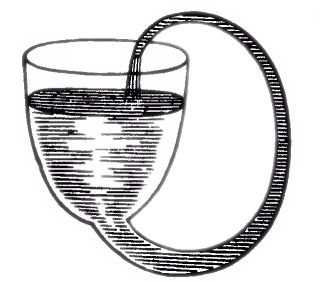
The process of philosophy is unfortunately often an exercise in mincing words across numerous tangents while the original topic fades into oblivion; this is not surprising, as definitions tend to be important in the process of understanding. However there is a systemic fault in relying on words to define our experience, namely, that words are objectively meaningless. In order to define a word words must be used, and these words have definitions themselves; the image then is of a cloud, a highly connected network that has no foundation--it depends entirely on itself for structure, like Boyle's self flowing flask:


Suppose that a Thing starts as not understood but can become understood, and that each Thing has a definition, which is a specific collection of Things. In order to understand a Thing you must understand at least one of the Things in its definition; if a Thing has no Things in its definition, it is not understood (naturally). Do you see the problem? With this arrangement of rules understanding seems entirely impossible because each definition invariably leads to more definitions. But all is not lost.

Suppose that there is a property called self evident, which is the very special occurrence of a Thing that is in its own definition; a self evident Thing is understood by default. With the inclusion of self evidence defined Things become understandable.

What is an example of a self evident Thing? Pick a number, any number!

Foundationalist philosophers seem like proto-mathematicians--a consequence of not recognizing that self evidence doesn't need to be proven, as it is enough to simply assume for the sake of argument. In an axiomatic system, the axioms are always assumed to be true. This is not done in order to answer the questions that the axiom might pose ("do parallel lines ever cross?"), but in order to derive many more interesting implications. The geometry that most people are familiar with is Euclidean geometry, and every single fact in Euclidean geometry can be proven to be a consequence of five axioms:
  1. Two different points can be connected by one and only one line.
  2. A line segment can be extended to produce an infinitely long line.
  3. A circle can be described with a point and a radius.
  4. All right angles are equal to one another.
  5. The parallel postulate: If a line segment intersects two lines forming interior angles that sums less than two right angles, then the two lines will intersect on that side of the segment.
From this simple set of rules, an obscene amount of useful consequences have been derived. In order for an axiom to be such, it mustn't be false according to any of its axiomatic peers, but there is nothing about these axioms that make them universal and inviolable outside their own system. The truth is that there's nobody more critical than a mathematician, and as a critic it is expected for them to raise objection: "Regarding axiom 5, what if two parallel infinite lines eventually cross?" or "What if all the conditions of axiom 5 are met but the lines still don't cross?" What this represents is not idle trolling, but rigorous curiosity. The objection is actually a new postulation that can be tested, and if ever a contradiction arises as a consequence of the postulation, the whole axiom can be rejected. In fact somebody raised this very objection, and after much time and effort no contradiction was found; instead, an entirely new branch of mathematics had been formulated. This non-Euclidean geometry would have no known real world application for more than 60 years, until it became the mathematics necessary to describe Einstein's theory of general relativity. Similar to mathematics, science is the process of discovering physical, measurable Things that are self evident--physical laws--that will not only explain all previous observations but also expose physically meaningful logical consequences.

The applicability of mathematics to reality is regarded as a great mystery. However, in terms of the rules above the applicability of mathematics to reality makes sense; indeed, how else might we know the universe? If there were no people around, it would be clear that reality isn't expressed in words. What we have come to know is that our experience of reality is the reception and translation of numbers and mathematical structure. When I suggest the color yellow, the thought of yellow occurs, maybe yellowish things: sunflowers, dandelions, etc, but yellow isn't defined by yellow things. What we've named yellow is actually photons oscillating with a wavelength around 570 nanometers--colors are by definition numerical, despite our experience of them as a visual cognitive phenomenon.

The case of colors is particularly interesting, because without the use of science to establish a self evident, or experimentally verifiable, numerical fact (wavelength) it is impossible to define color. There is an idea called qualia, which refers to some kind of purely subjective experience; for instance, even though most people will call a primary color by the same name, there is no guarantee that we experience the same thing. In other words, I might experience roses as what you see for the blue wavelength, but since Roses Are Red and everything I see that's called red is the same color as roses, my blue is your red. We will still agree on what items are red and what aren't, despite the fact that my subjective experience is not what you'd describe as red based on your subjective experience of light. Consider the following questions: What does pain feel like? What does a violin sound like? What does sweetness taste like? Qualia can be regarded as a word for the confusion and difficulty that comes with trying to answer these questions, particularly evident if these questions come from someone that doesn't possess the sense in concern, and thus can't gain understanding on the basis of related sensations. Qualia is still fiercely debated, and I'm not much surprised; behind every big debate there is a very ill posed question, but this doesn't imply that our experience is unquantifiable.

Consider the humble computer desktop: without a monitor, the modern desktop is apparently nothing more than a metal box that uses a lot energy in the form of electricity to warm the air. Without special tools, the only indication of activity is a light that's on when the machine is blowing out warm air, and a light that blinks at apparently random intervals when the first light is on. If this headless desktop were an alien instrument, deciphering its function would be extremely difficult. Even looking deep into the hottest part of the machine there would be perplexity abound, and a robust overwhelming with the realization that each of the over 2 billion elements might change state more than a billion times every second. Measuring the states of all of these elements at every step would be difficult given that each feature is smaller than the shortest wavelength of visible light. Even if that problem was solved, making sense of 1 second worth of data would require analyzing around 2*10^18 binary elements, which would require over 227,373 terabytes, or 222 petabytes. Even Then, the bits zooming around a CPU and patterns of gates give essentially no indication of what a computer is used for. Binary is just another way of representing quantity or number; we use decimal, which is base 10, which is kind of like saying we represent numbers with 10 different inherently meaningless symbols: 0 1 2 3 4 5 6 7 8 9. Binary is base 2, the only symbols are 0 and 1, but those symbols are equally sufficient to represent integer quantities. Thus, were you to look at the innermost workings of a CPU, what you'd see is voltages passing through a grid, sometimes changing and sometimes not. The problem is that seeing these voltages as decimal numbers wouldn't bring a modicum of sense to the madness. Even deciphering the relatively simple outbound digital video signal would be an uncanny feat; it would require a leap of imagination something like listening to Morse code and thinking that what you were hearing was actually triplets of values for a large array of photon emitters, plus whatever communication is part of the digital video standard. Some standards require two way connections, which means that before you could even draw the principal signal you'd have to have a precisely correct conversation with the machine that you're trying to figure out in the first place.


Consider the humble human being... I bet you see where this is going. Without motor function, the modern human is apparently nothing more than an elongated tube that uses water and a lot of energy in the form of food to warm the air and make fertilizer. Without special tools, the only indication of activity is from autonomic nervous function. If this were an alien instrument, deciphering its function would be extremely difficult. Even looking deep into the hottest part of the machine there would be perplexity abound, and a robust overwhelming with the realization that each of up to 100 billion elements might change state as many as 100 times every second. Assuming only full action potentials matter, and that this results in a binary signal, making sense of 1 second worth of data would require analyzing around 10^13 binary elements, which would require over 1 terabyte to store. Even Then, the bits zooming around a brain and patterns of neurons give essentially no indication of what a brain is used for. Were you to look at the innermost workings of a brain, what you'd see is voltages passing through a grid, sometimes changing and sometimes not. The problem is that seeing these voltages as decimal numbers wouldn't bring a modicum of sense to the madness. Even deciphering the relatively simple outbound analog audio signal would be an uncanny feat; it would require a leap of imagination something like looking at a continuous squiggly wave and thinking that what you were seeing was actually combinations of patterns for an abstract representation of physical phenomenon, plus whatever communication is part of the social standard. Some standards require two way connections, which means that before you could even draw the principal signal you'd have to have a precisely correct conversation with the machine that you're trying to figure out in the first place.

Is it possible to quantify the chemical senses of smell and taste? There are multiple ways on multiple scales, the most obvious: scents and flavors are particular molecules which are specific arrangements of atoms. Every atom is defined by quantities (mass, charge, etc), and the specific spatial arrangement of atoms that defines a molecule can also described mathematically... so even chemical sensation is merely an interpretation of numerical and mathematical structure. It may seem as though the mathematical definition of chocolate cake wouldn't make for much of a treat, but I'm suggesting that the mathematical definition is in fact the tasty part; there is no such thing as chocolate cake, only a variety of mathematical structures that are referred to as chocolate cake. If someone were to condense the sophisticated structure of chocolate cake down to a few succinct mathematical theorems written on a page, you wouldn't call the page chocolate cake, you'd call it a recipe; the recipe is a way to translate and understand chocolate cake, but without the quantization of the cake in some form, memorized, written, or otherwise recorded, there would be no cake. This comes across as very absurd, but consider the fact that there is no such Thing as chocolate cake; because "chocolate cake" can be interpreted as an exceedingly large range of Things, there is no objectively consistent Thing that is chocolate cake. This is different from self evident Things, which are objectively consistent; light with a wavelength of 570 nm will be light with a wavelength of 570 nm, even if you name it chocolate cake. Without a numerical level of specificity there is little assurance that everybody can and will interpret correctly.


We may never know...
Take the example of the aged philosophical question: "what is the meaning of life?" Perhaps the reason it has gone unanswered for so long is because it's an ill defined question--perhaps the question doesn't even make sense! Just because it is frequently repeated doesn't mean it is well defined. Do any of these similar sentences make sense?
  • What is the meaning of rock? 
  • What is the meaning of light? 
  • What is the color of life?
  • What is the interpretation of life?
  • What is the sound of a vacuum?


On an almost entirely unrelated note, I was pleased to find that Google had the wisdom to include the ability to search for images free for re-use, which made it very easy to produce the above image without fear of accidentally stealing the intellectual property of some profitably litigious organization. Lately I've seen this practice of open and alternative licensing (Creative Commons, GNU General Public License, etc.) referred to as copyleft. What that means I amn't certain, but regardless this free functionality provided by Google offers me a modicum of comfort given that the FBI is apparently more concerned with copyright violation than identity theft and missing persons, as noted on /. recently. As usual the law is really too complicated for "free for re-use" to make much sense; for example the fair use doctrine, which may or may not save one's ass in court if it comes to that.

    Monday, August 16, 2010

    Spectrogram of a Swept Triangular Wave

    I was going about in my typical atypical way and by chance did discover a very attractive fractal that is the frequency spectrogram of a swept triangular wave. I made this quick and dirty animation of a ping-pong zoom of it:


    This was done with Audacity, GIMP, and NCH Tone Generator, all of which are free--my thanks to everybody who ever contributed code to any, it should be known that my thanks is an exponential function, for anybody who may have contributed to more than one. Also, thanks to anybody who understands any of what I write.

    It should be noted that a number of other interesting fractals can be generated, depending on the wave type and the sweep.

    Wednesday, June 16, 2010

    Garrett Lisi: Unification Theorist

    Garrett Lisi is a particle/theoretic physicist who has come up with a very intriguing theory, one that mathematically unifies the quantum and relativistic branches of physics. The theory is fascinating and attractive, despite being essentially beyond comprehension. I had read about his theory at some point a while back and found it of general interest and know I've brought it up in discussion many times. Those times though my recollection was poor and didn't communicate the very important bit that is the author's name, but now I don't think I'll forget.

    Unification is of course the holy grail of modern physics, an achievement similar in magnitude to curing cancer. A great thing about Lisi's theory is that it makes predictions which should be answered when the LHC makes it to full power. I have mentioned already that the theory is naturally appealing, and I wasn't lying: his paper is the most downloaded of all on arXiv.org, which is probably the largest online collection of pre-print scientific articles.

    At the 2008 TED Lisi gave a presentation, his attempt at a lay explanation of the theory. You might want to take a moment to breathe deep and clear your mind before you watch...


    Thursday, May 13, 2010

    Iteration

    I've added threaded scene capture to my ray tracer so that I can make animations. Combine this with a map of the Mandelbrot set, and you can do things like this:


    This animation also uses the reflection model of the ray tracer to complicate things a bit near the end, as you may have noticed.


    One of the first animations I got out plays like a short film:


    This result was accidental, I had meant to iterate by floating point values but was casting to integers at the wrong place; as it turns out, some interesting things happen around integral values.

    If that's a short film, this might be a summary of that film:


    note that I practically always display the set with a basis orientation contrary to convention--this is mainly because the blobs lend themselves more readily to anthropomorphizing than the alternate, and are thus naturally more aesthetic.


    The following shows the set lights off and lights on:


    In fact, the only difference between the two (IIRC) is that for the second I added an additional light to the ray tracer.

    Thursday, March 25, 2010

    Computer Graphics

    As part of my course on computer graphics this semester the class has been writing a ray tracer. The details of ray tracing aren't really worth going into, instead I'd rather share a picture (more technically a rendering) that is the result of my work.


    If you are particularly learned, you'll recognize this figure as the Mandelbrot set. In case you didn't recognize it, at least you will in the future! This version in particular is really an abuse of the ray tracing engine we've developed; typically other much more efficient means are used to generate an image. However in using the ray tracer I'm able to generate images that simply couldn't be done with the more traditional methods. For instance, this rendering uses a reflection model to add an additional layer of the delicious recursiveness that characterizes fractals. Though you could do the same given the more traditional code, simply having the code alone versus a ready-made rendering program allows me to color the actual Mandelbrot set, which is almost always left black:


    For the sake of completeness, here's a more traditional ray traced image that specifically includes a good variety of capabilities a ray tracing engine made in a single undergraduate semester has:


    As you can tell, my cylinder code still has some issues that need to be resolved.

    Tuesday, March 23, 2010

    By the Numbers

    I presume most people recognize that there is a vague connection between statistics and probability, but, having taken a course in probability theory, I'd be willing to bet the farm that very few people realize the full breadth of intimacy between the two. This is true in particular because despite having studied both, I'd count myself as one amongst the naive. From the outset probability is simply difficult, and often counter-intuitive. Not only does probability proceed in ways contrary to our intuition, it does so in such an amazingly tricky way! Maybe it is a function of how easy it starts out: given a typical six sided die, most everyone knows that the chance of guessing which number comes up is one in six. Easy enough, you pick one side out of a total 6, so the probability is 1/6. The common understanding of probability stops there, for the simple reason that any situation even marginally more complicated than that becomes remarkably more logically and mathematically sophisticated. Suppose I'm flipping a coin and you're guessing the results. For some reason you're having terrible luck and you've guessed wrong 10 times in a row, what's the probability that you guess the next flip wrong as well? Think about it for a minute and when you've logically arrived at what must certainly be the answer, highlight the following space for the answer:  1/2

    Next, try to logically deduce the probability of guessing incorrectly for 10 coin flips in a row. Answer:   1/1024

    It only gets so much worse from there, to the extent that I'm really not confident I could present the correct answers myself! Even admitting that I can't help but try for one more. Assume that 4 out of 5 people prefer Crelm toothpaste. What's the probability that from a selection of 5 people 4 of them prefer Crelm? Answer (I think): 256/625

    The important notion here is that a probability says something both nebulous and concrete about reality. If a truly random die is thrown 6 million times, in all likelihood each number will have come up about 1 million times. If 4 out of 5 people really do prefer Crelm, then the chance that a randomly selected person prefers Crelm is 4/5 or 80%. As much as we all like to think that the statistics don't apply to us (because we're special), if the statistics are accurate there's no way to escape them. Most of the time this is a banal statement, as when referring to whether or not you prefer Crelm--either way it's not exactly a big deal. But then... there are the other statistics. "Around 50% of US marriages end in divorce" can be a pretty hard pill to swallow for a couple walking down the aisle. I have reason to believe the number of couples who'd figure they end up on the successful half of that statistic while exchanging vows is much higher than 50%--clearly if they thought it wasn't going to last they'd probably not be entering the commitment in the first place. Similarly, doubting the success of the marriage from the outset probably isn't going to increase the chance of a favorable outcome. What's left is an awkward position, objectively maybe the best one can think is that at least the odds aren't as bad as they could be, better than any casino game. However marriage is a particularly special case for a number of reasons, the primary one being the shift in locus of control which is applicable to all interpersonal relationships; though a bit less severe, anyone who's been dismayed by the lack of a second date (etc.) knows the score. To be fair the actual divorce rate changes based on many factors, where 50% is just the overall rate. The lowest divorce rates are found in each of the following categories: first marriage, atheist or agnostic, age 30 or older, residing in the Northeast and no cohabitation prior to marriage.

    Uncontrollable statistics naturally lead to other more personally manageable probabilities. For instance, 28% of car accidents in the US happen while at least one of the drivers is using a cell phone. This is the part where I reiterate: we love to think we're special and that the statistics don't apply to us, but it just doesn't work that way. We are all special, I'm fully on board with that, but that doesn't grant any of us statistical immunity. Using a cell phone while driving (even with a hands-free headset) substantially increases the chance that you will be in a car accident, which could result in your death, or, arguably worse, the death of another/others with the accrual of manslaughter charges and the lifelong burden of knowing that you've killed someone. It's very simple: while the car is in gear, your phone doesn't exist. There are absolutely no excuses.

    Saturday, September 19, 2009

    Information, a perspective

    Fair warning: I'm about to talk about math. However, I don't think you need to know or even like math to enjoy this. Suppose I were to tell you that the following images were both of the same thing. Would you believe me?


    Unless you know multivariable functions or are pretty slick, you probably think I'm crazy. However, I can assure you that these are simply two different perspectives of the exact same shape; the only thing that has changed from one to the next is the place from which you are looking at it. If you're a skeptic (and I hope you are), you still don't believe me. Fair enough, but look at the animation after the jump and you don't have to believe me--you will see it with your own eyes.