Showing posts with label mindblowing. Show all posts

Saturday, June 9, 2018

Juno Reactor - Komit (3 Of Life & Domestic Remix)

I'm back from the dead to inform you that this remix is hot like burn your face off radiation


here's a fractal to take with it, 1549


I've been yearning/searching for a branch from early goa music, with maybe a twist of deep drum and bass... so, finally!

Monday, November 15, 2010

Reality made Virtual

In case you hadn't heard, Microsoft recently released a new accessory for their game console called the Kinect. Without going into much detail, the Kinect is packed with some advanced electronic sensors. Some people are unwilling simply to take what has been offered them as it is--these are true, free individuals, actively exercising volition; call them hackers. Within days of being released, the Kinect was unleashed, hacked to fill a bounty. Here we are, 11 days later, and one hacker has built on top of the work of other similarly intrepid minds something profound; as seen on hackaday, it is reality made virtual:


Sunday, October 10, 2010

Artificial Intelligence

Maybe I've said it before, but the idea that any intelligence can somehow be artificial feels misleading. If you separate the element of humanity from intelligence, it is easy to see that all intelligences are real, not artificial. On the other hand, the concept of artificial doesn't make any sense to me to begin with. Regardless, consider the mechanical structure of the mammalian nervous network: it is indeed a network of trillions of cells, little nodes, communication points. When you touch something, a change in net potential electrical charge of ions over neural cell membranes travels from your fingertips through nerves (made of neurons) to your brain. When it enters your brain, it traverses a number of distinct pathways en route to the mammalian cerebral cortex, which is a recent development in Life; mammals specifically have this part of the central nervous system, whereas lizards and other less evolved creatures do not. This construct of many individual nodes networked into some meta entity with whatever emergent properties is not a unique one though. Perhaps the greatest example I can think of other than the brain is this thing called the internet--it too is composed of many networked nodes, and in several senses of the word. For one, the internet works thanks to a tremendous amount of electronic switching nodes, which are in many ways similar to the neurons of our own brains. Alternatively, perhaps people are nodes in this "higher" mind called the Internet, each mind some small part of a more complicated implementation of consciousness. It is difficult to say with any certainty if the systems of switches and wires performing our rote requests is experiencing some kind of consciousness--after all, how could we tell? We can't even measure or readily define our own conscious experience, how are we to begin to hope to communicate with this higher mind!? Even then, it is certain that the construction of this higher mind is very different from the mammalian brain, and doesn't this seem to strongly suggest that its experience or manifestation of consciousness would likewise be very different? I'm reminded of higher dimensions: when you think about one, two, or three dimensions, things make a reasonable amount of sense. But when you get into higher dimensions, even just four, things cease to make hardly any sense at all. So imagine it from a different perspective, one conscious dimension lower than the one we're used to: if you were a cell, one among trillions, could you even begin to imagine the everyday human experience? And yet cells are stupendously sophisticated machines, sophisticated enough to prevent us from answering many questions about human health, answers they have to reveal.

It goes without saying that the value of science is very real, which is another way of saying that our intuition frequently misleads us--if thinking alone were enough we'd have faster than light zero-energy transportation and the galaxy would be colonized by now because the easiest way to do those things would be obvious, as obvious as the Earth revolving around the Sun nearer the edge of the Milky Way galaxy among hundreds of billions of others. Once it is seen that our rough draft perception of things is generally wrong, the confidence in human intelligence erodes, and I think makes a stronger case for "intelligence" being something not anthropospecific.

Note it is institutionally correct to capitalize Internet; it is a proper noun. Even if all this somewhat ambiguous babbling about higher minds is patently false, there's no loss in the magnitude of the Internet. For certain it has become something fairly hard to define on all levels, and regardless a boon to our lifestyle to an inconceivable degree. Imagine, if some great mind were born a few decades ago just a bit too lazy, they might never flourish for lack of access to information. Now however, an inconceivable amount of information is literally available at our fingertips (I was just getting a refresher on the mesencephalon, and earlier I was playing with Wolfram Alpha which can show you how to solve even ambiguous equations like 2x3 - 6.543x = x2, among many other things). If there were any aspiring minds starved of information before, there are definitely a lot fewer now.

Sunday, September 12, 2010

The Universe is Impossible: A Proof

A set is a group of things, ex: {dog, food}
A subset is a set that has only things also in the super set, examples: {dog}, {food}, {dog, food}
A power set is the set of all subsets, ex: {(dog), (food), (dog, food)}.

It follows that the number of things of things in a subset is less than or equal to its parent set, which is in turn less than the number in its power set.

...prepare for mindlblowing...

Suppose there is a set of all things called the universe, then any set must be a subset of the universe. But this implies that the power set is a subset of the universe, which is a logical contradiction since the power set is larger than the universe. Thus, the universe doesn't exist.

Tuesday, July 6, 2010

Matter and Electromagnetism

With precisely 20 minutes of focus anybody can come to know a very significant portion of the foundation of our physical reality.


Wednesday, June 16, 2010

Garrett Lisi: Unification Theorist

Garrett Lisi is a particle/theoretic physicist who has come up with a very intriguing theory, one that mathematically unifies the quantum and relativistic branches of physics. The theory is fascinating and attractive, despite being essentially beyond comprehension. I had read about his theory at some point a while back and found it of general interest and know I've brought it up in discussion many times. Those times though my recollection was poor and didn't communicate the very important bit that is the author's name, but now I don't think I'll forget.

Unification is of course the holy grail of modern physics, an achievement similar in magnitude to curing cancer. A great thing about Lisi's theory is that it makes predictions which should be answered when the LHC makes it to full power. I have mentioned already that the theory is naturally appealing, and I wasn't lying: his paper is the most downloaded of all on arXiv.org, which is probably the largest online collection of pre-print scientific articles.

At the 2008 TED Lisi gave a presentation, his attempt at a lay explanation of the theory. You might want to take a moment to breathe deep and clear your mind before you watch...


Thursday, May 13, 2010

Iteration

I've added threaded scene capture to my ray tracer so that I can make animations. Combine this with a map of the Mandelbrot set, and you can do things like this:


This animation also uses the reflection model of the ray tracer to complicate things a bit near the end, as you may have noticed.


One of the first animations I got out plays like a short film:


This result was accidental, I had meant to iterate by floating point values but was casting to integers at the wrong place; as it turns out, some interesting things happen around integral values.

If that's a short film, this might be a summary of that film:


note that I practically always display the set with a basis orientation contrary to convention--this is mainly because the blobs lend themselves more readily to anthropomorphizing than the alternate, and are thus naturally more aesthetic.


The following shows the set lights off and lights on:


In fact, the only difference between the two (IIRC) is that for the second I added an additional light to the ray tracer.

Wednesday, April 7, 2010

SparkFun SEN09423 integration issues

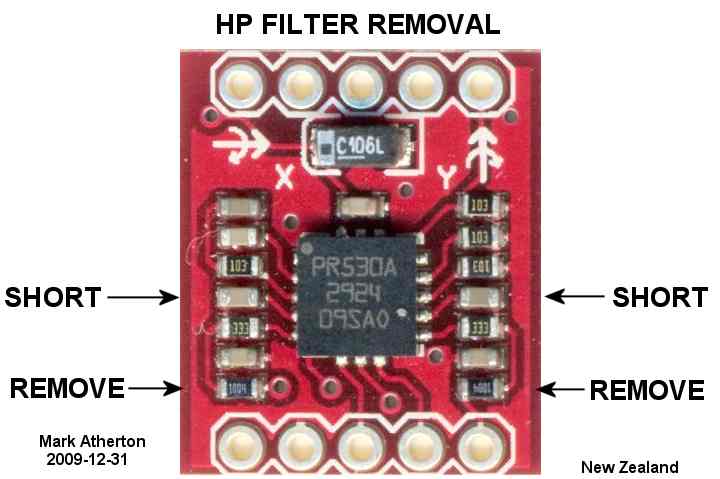
Anyone seeking to use SparkFun's SEN09423 breakout board for the LPY530AL as a position sensor should be advised that the two 4.7 µF capacitors (C1 and C2 on the schematic) used for the high pass filter need to be removed and the contacts bridged. This image shows which tiny bits are of concern, however note that it seems the resistors indicated therein do not need to be removed. This information comes thanks to a few people who know what they're doing (which excludes myself), as discussed on the SparkFun forums here and here. From what I gather this may be an issue with numerous (all?) SparkFun breakouts including ST rate gyros, the two threads alone implicate boards containing LPR530AL or LPY530AL, including the IMU 6DOF Razor. This is a particularly odd case because Inertial Measurement Units are mostly used for dead-reckoning, and the inclusion of these caps will effectively frustrate anyone with such an intent. As far as removing them, good luck! Here's my own picture of how gigantic these caps are:


I found the best luck (given a fine tip soldering iron) with adding a little solder to one side so that solder wick can get most of it. Then just heat up the other side and push gently. The first one I removed took the contact pad with it, if that happens to you you may or may not be high and dry. I managed to salvage the situation by drawing between the appropriate areas with a pencil. In case you weren't aware, graphite is conductive--clearly this is a handy bit of information on occasion.

For a slightly more general audience, here's some interesting information. The capacitors pictured are about 0.065 inches wide, or 1.66 mm; the skinny dimension of the penny pictured is about 1.52 mm. I said these capacitors are gigantic, and relatively speaking this is true! Relative to molecules, light rays, and subatomic particles sure, but also relative to the vast majority of capacitors out there. We will get to how in a minute, but first a brief overview. The electronic components most of us are used to seeing are the ones attached to those (usually) green boards also known as circuit boards, like this one:


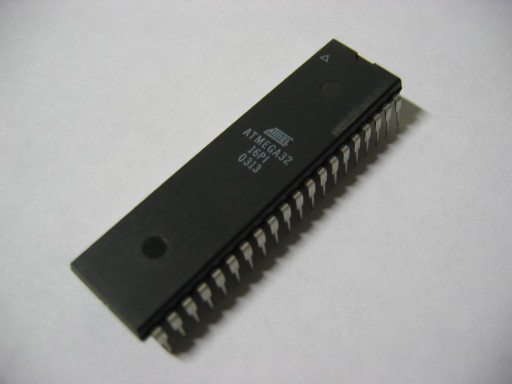
These days most circuit boards we encounter are printed circuit boards or PCBs, called such because the production process resembles printing to varying degrees. The principle elements of a PCB are, put simply, fiberglass, copper or other conductive metal, and solder mask. The fiberglass makes up the board-ness, the copper is akin to wiring for conducting electricity amongst the components, and the solder mask, the colored part, is a coating that solder doesn't stick to, in place so that connections aren't made accidentally by wandering solder. Not too long ago, I thought the PCB was made of silicon; after all, electronics are associated with silicon, and from a naive perspective the shiny green board looks like something that might be called silicon. But if that's not it, where's the silicon? In an IC of course! These days most all the action of an electronic device happens in an Integrated Circuit, which looks something like this:


Inside that chunk of plastic there's a wafer of silicon, which could contain anywhere from hundreds to Billions of electronic components. Wouldn't it be nice if there was a window that showed the silicon? Like this one?


Instead of discrete components like the capacitors I shared above, these components are formed by spraying (very precisely) successive layers of various chemicals in a process called photolithography, resulting in something like a miniature PCB. The CPU is the biggest, most complicated IC in the box that is your computer (unless you have a very fancy video card), and because of this it looks different than all the others. For one, you can't even see it, it's hidden underneath a big heatsink, which is there to help get rid of all the electricity that turns into heat in the CPU (the process is conceptually similar to heat generated from friction). CPUs generate so much heat that one would burn itself to a crisp almost instantly without a heatsink. But even if you remove the heatsink (after you've turned off the computer), modern processors have another metal plate which hides another sealed package that finally contains the silicon. Here we're finally at the land of magic: as of now, April 2010, Intel has a 32 nm manufacturing process, which means that the typical component width is less than 32 nm. This also means that the 1.66 mm wide capacitor above is about 52,000 times wider than a single component on a 2010 Intel CPU, or, relatively gigantic. Granted, most things we know are relatively gigantic compared to 32 nm, particularly since that's quite a bit smaller than the shortest wavelength of visible light--violet, at 400 nm. Reality check: we're making electrical components so small that a ray of light can't even hit them, so small that even the most powerful microscope couldn't see them, way smaller than the average bacteria. Really!? Apparently that's not enough, industry projections have us with 11 nm chips in 2022, which would make each component about the same width as 55 carbon atoms. Interestingly, the first time a single carbon atom was photographed (after a manner) was 9/2009. Of course, there are certain problems that what we know as computers, that is Turing class machines, can't solve--certain problems that could be described in a hundred or so lines of computer code that would take a computer the size of the universe longer than the universe is supposed to exist to solve. Not content to take limitations as they're handed to us, work is well under way to develop a different class of computer: the quantum computer. Quantum computers are very different in that they can take very specific problems, like the one I just mentioned, and solve them instantly. I don't know enough about quantum computation to judge if they'll ever reach the ubiquity our Turing machines have, but I can say one thing for certain: there's not much certainty in the future! Intel will probably plug ahead and reach 11 nm in 2022, but the real question is will that even be relevant? I'm willing to bet not, it almost seems like sitting in 2002 and projecting that by 2012 our CPUs will run at 11 GHz; as it turns out, GHz aren't all that important. Take a top of the line 3.8 GHz Pentium 4 from 2004 and I assure you a 1.8 GHz chip from today will outperform it. Maybe the state of the art in 2022 will be a 100 MHz chip with a million cores--only time will tell.

Friday, March 19, 2010

Technology II: State of an Art

For today's exercise, please read the following passage and give the question at the end a sincere and thoughtful rumination. Once you feel you've thoughtfully ruminated enough, watch the video.

Imagine a modern machine, one that could be called a robot, that consists of a three fingered hand mounted at the end of an arm with a range of motion similar to our own and a single camera. Given the present state of technology, which any sensible person would describe as "quite advanced," what might this arm to be capable of?


It is astounding, yes, no less should have been expected, but there is something a bit backwards about it. Traditionally machines are constructed and used because they can do some certain task vastly better than we are able to. Naturally the machine's form and means of manipulation don't resemble ours in the slightest, otherwise we'd probably not have needed it in the first place. A good number of years ago, enchanted by the ideas of Isaac Asimov, I had a strong interest in androids--humanoid robots. But even before I knew the beginning of the true technical challenges behind building an android I realized something: a person desiring to make a passable humanoid machine would save themselves a lot of effort and greatly increase their probability of success by doing so the old fashioned way, that is by seeking a viable mating partner and letting nature run its course. At the time the thought was conceived mostly as a joke, and though it's still humorous, it's also quite sensible--practically speaking I think we have more than enough roughly human shaped objects with adequately human like capabilities. Nonetheless it is almost certain that many will continue attempts to build an android, and it's far from difficult to imagine that one day a result could be described as nothing other than successful. However one thing will remain true even then, even when androids exceed our capabilities: the human form can't do everything. No matter how dexterous or sophisticated, our fat fingered mechanical offspring won't be able to manipulate the atoms of a molecule unaided; even less technical, these two handed automatons will have just as much trouble as we doing the work of three hands. This will be a small victory for three handed people as they will get to remain not yet obsolete longer than the rest of us, at least for the few moments it takes to add one more hand to the robot. All silliness aside (well ok just most of it), there's clearly a huge number of tasks which won't benefit from the superhuman but still human capacity of these imaginary androids unaugmented. This represents a significant relief since we aren't stuck waiting for these super androids to come along (which nonetheless probably isn't too far off, though given the rate of technological progress, relatively probably quite a ways off). In summary, I've basically stated in a very roundabout way that we are free to continue to augment our own similarly limited mechanics the same as we have since the invention of the first tool; we can use our already inconceivably sophisticated body of technology to extend and enhance our capabilities. Case and point, the da Vinci surgical robot. Surgeons are essentially required to have superior motor control as even the slightest irregular movement could result in a fatality. However, no matter how talented the person holding the knife with intent to open you up, there is a fundamental biological limitation to the amount of accuracy they are capable of. Rather than just hoping their home life isn't distracting them and that their cup of coffee wasn't abnormally strong that morning, the da Vinci confers peace of mind with a laundry list of features specifically designed to maximize precision by counteracting the inherent imprecision of human hands. There are over 700 worldwide, and though it is only approved for a limited number of procedures, the number is expected to continue increasing as rapidly as it has been. While it's already on it's second version, I think it's a safe bet that further enhancements will be rapidly forthcoming. Of course, the proof is in the numbers, and the numbers are unambiguous--given the choice between traditional and robot assisted surgery, choose the latter! Here's a video of it peeling a grape on live television:


In conclusion, I'm compelled to once again say the same thing I've said previously: over the past few decades in particular we've been developing foundational technologies. Because each of these have such vast potential for application, the first and most obvious few applications took hold and found success. Being as we are focused on a multitude of things wholly different from the vastness of yet unrealized and incredible possibilities that these technologies enable, it is natural to unconsciously assume that what we see is more or less the extent of what technology can offer, but this tacit assumption is, in my opinion, absolute rubbish. In particular the most overlooked and underutilized technology is cheap and powerful microprocessors; everyone knows that desktop processors keep getting more powerful without getting more expensive, but the bit of interest is that the processors of yesteryear continue to get smaller and cheaper. This fact in itself isn't unacknowledged, actually there's a well known meme that suggests a common calculator found in a high school today has more processing power than the space shuttle that delivered the Apollo astronauts to the moon and back. The overlooked bit is that that little processor can do an awful lot more than help with algebra homework. Like what? Well, I have a video demonstration of one such device, but before you watch it consider that the processor in the device shown is essentially as powerful as a 1986 state of the art desktop that cost $6500 (the Compaq Deskpro 386), can be had for around $3, and is smaller than a dime. The whole device could probably be made wholesale for under $10.

Thursday, March 4, 2010

Ramachandran on the encephalon

Vilayanur Ramachandran is a neurologist. What's more is that he has a very keen insight, and a particularly effective ability to communicate. Given that the nervous system (including the brain) is naturally and rapidly a profound topic of consideration, such a person as Ramachandran could really make 20 minutes intriguing. Well it was 23 actually, but I'm willing to wager nobody in the room wanted him to stop.

Wednesday, January 20, 2010

Max Richter

Max Richter is a contemporary classically trained composer and musician. By my judgment he is absolutely a musical prodigy, certainly amongst the most gifted musical artists of this time. His pieces can often be characterized as avant-garde as he blends modern and classical elements, breaking conventions to enable the forging of some extraordinary, transcendental aural experience. Interestingly his Wikipedia page mentions him "commissioning and performing works by Arvo Pärt, Brian Eno, Philip Glass, Julia Wolfe and Steve Reich" early in his career, which happen to be a few of my favorite artists. Predictably enough, his music has had a rather profound impact on my life several times over several albums. Nonetheless, I know enough to understand music is as subjective as it gets, to the extent that the reactions of others can be rather hard to predict. Well, there's only one way to find out; here's some evidence for my conjecture:


The thing is, like many great musicians, he doesn't just write songs, he writes albums. Thus, as great as this song is alone on this page, it is but a mere shadow of itself when played as part of the whole. I recommend purchasing all his albums, if only to ensure he's funded and motivated to continue producing lots of music for as long as possible.